 Loam & Leaf
Shape young apple trees during late winter dormancy. Remove crossing wood to allow sunlight into the interior canopy.
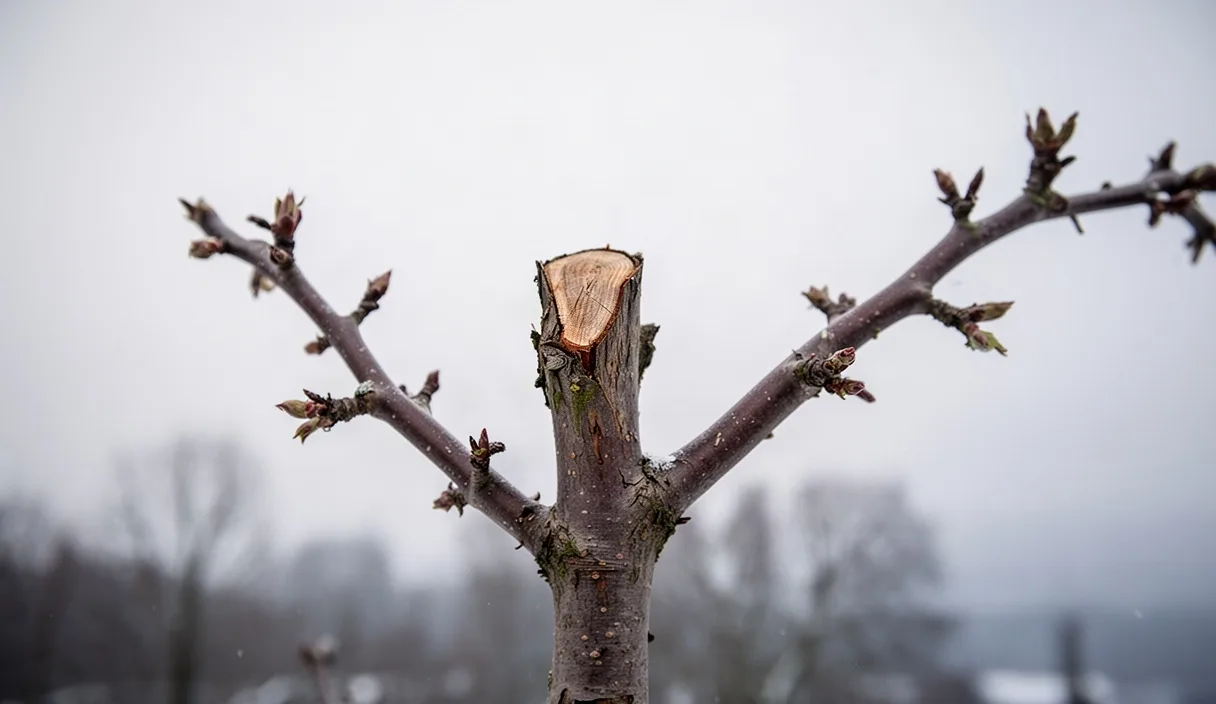

- Winter cuts direct strong spring growth.
- Removing inward branches improves light access.
- Clean bypass pruners prevent bark tears.
Apple trees carry fruit on wood that receives direct sunlight. The open center system removes the central trunk to create a vase shape. Sunlight enters the middle of the canopy. Air moves freely across the leaves and fruit spurs.
Dormancy runs from late November through early March in temperate climates. Pruning occurs during late winter before the buds swell. The tree loses less sap during this rest period. Pests and fungal spores remain inactive in the cold air.
Selecting dormant season pruning tools
Clean cuts heal without tearing the bark. Dull edges crush the cambium tissue beneath the outer layer. Three basic tools handle every branch diameter on a mature apple tree.
Bypass hand pruners cut small wood up to three quarters of an inch thick. Anvil pruners crush tissue and do not belong in the orchard. Loppers provide leverage for branches between three quarters of an inch and one and a half inches. A curved folding pruning saw with tri-edge teeth cuts limbs thicker than one and a half inches.
| Tool Type | Maximum Wood Diameter | Primary Use |
|---|---|---|
| Bypass Hand Pruners | 0.75 inches | One-year-old shoots, spurs, thin water sprouts |
| Geared Bypass Loppers | 1.50 inches | Two-year-old wood, secondary lateral branches |
| Curved Pruning Saw | 4.00 inches | Central leader removal, large scaffold limbs |
Whetstones keep steel edges aligned during cold field days. A 1000-grit diamond file fits inside a pocket. Five passes along the factory bevel restore the cutting edge after twenty cuts. Clean oil prevents rust between rows.
Locating the central leader
The central leader is the upright vertical shoot that extends the main trunk upward. In standard orchard models, this stem dominates the tree. In an open center framework, this stem must come out.
Stand six paces back from the south side of the tree. Trace the main trunk upward to the point where the first set of wide lateral branches emerges. The stem continuing straight up into the sky from this point is the central leader.
Conversion of an existing central leader tree takes careful marking. Choose a point just above the top selected scaffold branch. The target cut sits at an angle of forty-five degrees sloping away from the chosen branch bud. This angle sheds rainfall away from the raw wound.
Large cuts require three separate saw cuts to prevent peeling the trunk bark:
- Make an undercut twelve inches above the target branch, sawing upward one third of the way through the trunk.
- Place the blade two inches higher on the opposite side and saw straight down until the heavy top falls away.
- Make the final smooth cut just outside the branch bark ridge and collar at the base of the leader.
Never leave a long dead peg. A peg rots into the main stem over three seasons. Never cut flush against the trunk surface, because flush cuts destroy the support callus tissue.
Removing water sprouts and root suckers
Water sprouts grow straight up toward the sun. They appear on the upper surfaces of horizontal scaffold limbs during wet summer weeks. They produce soft wood, thin leaves, and few flower buds. They cast shade on productive spurs below.
Cut water sprouts back to the branch bark collar. Cut them flush to the collar, but do not cut into the collar itself. Leaving a two-inch stub encourages four new vertical shoots to form at the base next spring. If a canopy has an open sunburn gap, prune one water sprout back by two thirds to an outward-facing bud to form a replacement lateral branch.
Root suckers emerge from the rootstock below the graft union. They pull water and nitrogen away from the fruiting scion variety. They also provide entry paths for fire blight bacteria during warm spring rains.
- Clear dead mulch and soil away from the base of the sucker until its point of origin on the root appears.
- Sever the sucker directly at the root surface with a sharp knife or hand pruners.
- Avoid leaving an underground bud that can push new shoots later in the season.
- Replace the soil cover over the root wound to keep moisture levels stable.
Cutting inward-facing limbs
The center of an open vase tree must stay empty. Air currents dry the morning dew and prevent apple scab infections. Sunlight must reach the lowest fruit spurs along the scaffold arms.
Inspect each scaffold branch from the trunk outward to the tip. Identify lateral branches that point back toward the interior hollow of the tree. These branches cross one another within two seasons and rub their bark raw during windstorms.
Remove inward-growing shoots at their origin along the scaffold limb. When an inward branch carries good fruit spurs, shorten it to an outward-pointing bud or lateral fork. The remaining bud will direct future vegetative growth toward the perimeter of the tree.
Down-hanging branches also require removal. Shoots that hang lower than the parent limb receive poor light. Apples growing on drooping shoots touch the grass and pick up ground pathogens. Prune down-hanging growth back to a horizontal lateral branch.
Balancing scaffold branch spacing
An open center apple tree depends on three to five permanent scaffold limbs. These limbs support the entire weight of the fruit crop. They must attach to the trunk at strong angles.
Select branches with crotch angles between forty-five and sixty degrees relative to the vertical trunk. Narrow crotches, below thirty degrees, trap bark between the branch and the trunk. Trapped bark prevents the wood from knitting, which leads to split limbs under heavy crop loads.
| Branch Characteristic | Optimal Measurement | Correction Method |
|---|---|---|
| Vertical Spacing on Trunk | 6 to 9 inches apart | Prune out crowded intermediates |
| Radial Distribution | 70 to 90 degrees around trunk | Select shoots facing empty quadrants |
| Branch Crotch Angle | 45 to 60 degrees from trunk | Use wooden branch spreaders early |
| Scaffold Diameter Ratio | Under three-quarters trunk diameter | Subordinate with heading cuts |
Scaffold limbs should not emerge from the same height on the trunk. Branches that share a single whorl choke the central vascular ring. Space the attachment points vertically along the trunk by six to nine inches.
Walk around the tree to check radial balance. One branch should point northeast, one southeast, one southwest, and one northwest. If two branches run parallel in the same direction, cut the higher branch away to let light reach the lower branch.
Head back the tips of young scaffold limbs if they exceed four feet of growth in one year. Cut one quarter of the annual growth back to an outward-facing bud. This cut stiffens the wood and forces lateral spur development along the bottom half of the branch.
Sanitizing tool blades between trees
Pruning tools transfer viral, bacterial, and fungal pathogens. Fire blight bacteria live inside infected vascular tissue and stick to steel blades. Moving from an infected tree to a healthy tree without cleaning tools spreads disease across an entire row.
Rubbing alcohol with an isopropyl strength of seventy percent kills pathogens on contact. It does not pit steel blades like chlorine bleach does. Mix seventy parts isopropyl alcohol with thirty parts water if using high-test alcohol.
- Wipe tree sap and bark debris off the blade using a stiff natural-bristle brush.
- Submerge the tool jaws in an alcohol bath or spray both sides of the blade until wet.
- Allow the liquid to sit on the steel surface for thirty seconds before wiping it dry.
- Apply three drops of mineral oil to the pivot bolt to maintain movement.
Household chlorine bleach diluted to one part bleach and nine parts water also sanitizes tools. Rinse bleach off the steel with fresh water within five minutes, as chlorine pits carbon steel and ruins sharp cutting bevels.
Common mistakes
Pruning too much wood in a single winter forces the tree into survival mode. Removing more than one third of the canopy triggers an explosion of vertical water sprouts the following summer. The tree expends its energy on vegetative shoots instead of setting flower buds for next year.
Leaving stubs remains a persistent problem. A stub cannot form wound wood because it lacks a flow of sap. It slowly dies back into the parent limb, allowing wood-rotting bracket fungi to enter the core wood.
Making flat cuts against the main trunk removes the branch collar. The collar contains the chemical barrier zone that prevents decay from spreading into the heartwood. Always cut just outside the raised ring of bark at the base of the branch.
Pruning late in the spring after leaves emerge reduces tree vigor. The tree has already moved stored root starches into the new foliage. Cutting those branches off throws that stored energy away.
Practical next steps
Begin by walking the orchard while the branches remain bare. Mark potential scaffold branches with brightly colored surveyor tape before making any cuts. Step back to view the canopy from all four compass points.
Collect clean pruning tools, sharpening stones, and sanitizing liquid in a bucket. Remove the central leader first if the tree is being converted from a central leader structure. Clear out broken, dead, and diseased wood before selecting final structural branches.
Consult a certified arborist or an agricultural extension agent if limbs show large cankers, black rot, or structural trunk splits. Large limbs over six inches in diameter often require rigging hardware to avoid personal injury or property damage.
Rake pruned wood out of the orchard perimeter immediately. Burn or chip the brush to prevent overwintering codling moth larvae and fungal spores from reinfecting the trees as the weather warms.
This journal provides educational content only; consult your regional agricultural extension office for local planting dates and soil pathology. Disclaimer