 Loam & Leaf
Balance brown materials with green kitchen scraps for active decomposition. Prevent foul odors by adjusting your compost pile inputs.
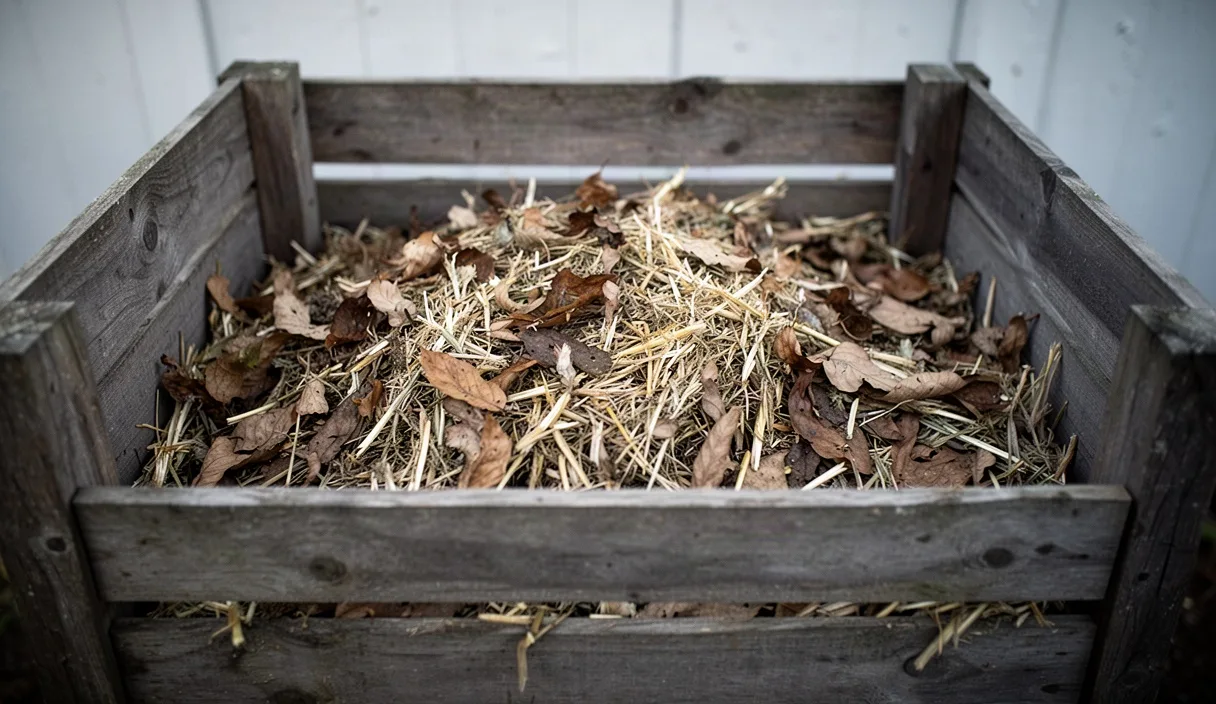

- Dry leaves supply essential carbon mass.
- Fresh green scraps provide active nitrogen.
- Regular turning introduces necessary pile oxygen.
Microbes consume plant tissue to build their cells and generate heat. They require two principal elements to carry out this work. Carbon provides their energy. Nitrogen provides the building blocks for their proteins and enzymes.
The relationship between these two inputs is the carbon to nitrogen ratio. It is written as C:N. When the ratio is balanced, decomposition moves at a steady pace. When it is out of balance, the heap either stops heating or releases nitrogen gas into the air.
Defining brown and green elements
Gardeners divide compostable matter into browns and greens. Browns are materials dense in dry plant carbon. Greens are materials dense in moisture and protein nitrogen.
The ideal target for microbial metabolism is roughly thirty parts carbon to one part nitrogen by dry mass. Fresh cut grass contains roughly twenty parts carbon to one part nitrogen. Dry autumn leaves contain roughly sixty parts carbon to one part nitrogen. Wood shavings can contain up to five hundred parts carbon to one part nitrogen.
| Material | Classification | Average C:N Ratio | Moisture Content |
|---|---|---|---|
| Fresh grass clippings | Green | 17:1 to 20:1 | High |
| Coffee grounds | Green | 20:1 | Medium |
| Kitchen vegetable scraps | Green | 12:1 to 15:1 | High |
| Poultry manure with bedding | Green | 15:1 to 18:1 | Medium |
| Dry autumn leaves | Brown | 40:1 to 80:1 | Low |
| Cereal straw | Brown | 75:1 to 80:1 | Low |
| Corrugated cardboard shreds | Brown | 350:1 | Very low |
| Hardwood sawdust | Brown | 400:1 to 500:1 | Very low |
Coffee grounds appear dark brown to the eye. They function as a green input in the pile because their tissues hold concentrated proteins. Wood ash contains minerals and potassium, but it contains zero nitrogen and negligible organic carbon. It does not count as either a brown or a green element.
Calculating the basic volume mix
C:N values refer to dry weight in a laboratory. Raw materials in a garden arrive with varying moisture and bulk density. Gardeners calculate their recipe by bucket volume instead of dry laboratory weight.
Wet greens weigh more than loose, dry browns. A single five-gallon bucket of fresh vegetable trimmings weighs far more than a five-gallon bucket of dry oak leaves. To strike a thirty to one chemical balance, the bulk pile requires more physical volume of browns than greens.
A practical recipe uses three parts brown volume to one part green volume. An alternative recipe for dense grass clippings uses two parts coarse wood chips to one part clippings.
- Select a standard container such as a five-gallon plastic bucket or a wheelbarrow.
- Count each container of green material added to the working site.
- Add two or three equal containers of brown material over the green layer.
- Rake the additions so they distribute in thin, alternating layers across the heap.
If you build with fine sawdust, reduce the brown portion to one-third of a container per green container. Sawdust packs tightly and presents a very high surface area. If you build with whole deciduous leaves, increase the volume to four containers to account for the loose air pockets between the leaf surfaces.
Aerating the central core
Microbes use oxygen to break chemical bonds in plant tissue. As the core temperature climbs above forty degrees Celsius, microbial activity speeds up. The microbes draw down the dissolved oxygen in the moisture films surrounding the particles.
Without physical air exchanges, the core becomes anaerobic within forty-eight to seventy-two hours. Anaerobic bacteria survive without oxygen, but they operate slowly. They produce pungent intermediate compounds like butyric acid and hydrogen sulfide.
Aeration restores passive airflow through the pile pores. Coarse materials create permanent chimneys inside the structure.
- Insert coarse sunflower stalks or small pruned branches at the floor of the bin to allow bottom airflow.
- Drive a compost aerator tool down into the middle of the mass and twist it to open air pockets.
- Turn the outside layer into the center using a five-tine manure fork every seven to ten days.
- Avoid over-turning, as turning every single day sheds heat and dries out the beneficial fungi.
Track the internal temperature with a probe thermometer that has a forty-centimeter stem. Push the stem into the geometric middle of the pile. A reading between fifty-five and sixty-two degrees Celsius indicates that both aeration and the carbon-nitrogen balance are active.
Moisture testing by hand feel
Decomposing organisms move across microscopic water films on the surface of organic particles. If the pile drops below forty percent moisture by weight, the bacteria enter dormancy. If the pile exceeds sixty-five percent moisture, water fills the pore spaces and blocks oxygen.
A hand squeeze test gives an immediate assessment of the water content. Wear a thin rubber glove before handling uncomposted materials.
- Dig twenty centimeters into the side of the heap to bypass the dry crust.
- Pull out a handful of mixed matter from near the middle layer.
- Squeeze the material firmly inside your closed fist.
- Observe the fingers and the base of your palm for water movement.
The pile is correct when the material feels like a wrung-out sponge. The skin of your palm should be wet, but no water should trickle through your fingers. If water runs out in a steady stream, the pile is too wet and needs immediate dry, coarse browns. If the handful falls apart into loose crumbs when you open your fingers, the pile is dry and needs a light spray from a garden hose.
Diagnosing cold or smelly heaps
Heaps communicate their chemical state through odor and temperature changes. Monitoring these signals allows you to adjust the ratio quickly.
| Symptom | Underlying Cause | Corrective Action |
|---|---|---|
| Sharp ammonia smell | Excess nitrogen present | Turn in two buckets of dry chopped straw or cardboard shreds. |
| Rotten egg odor | Lack of oxygen and excess water | Spread pile out to air dry, then rebuild with coarse twigs. |
| Heap stays at ambient temperature | Too much carbon or lack of moisture | Check moisture, add spent coffee grounds or blood meal. |
| Center hot, edges stone cold | Pile volume is too small | Increase total heap dimensions to one cubic meter minimum. |
| Pile attracts flies and pests | Exposed kitchen scraps on top | Bury all fresh greens under ten centimeters of brown matter. |
An ammonia odor shows that microbes cannot bind the available nitrogen. The excess escapes into the atmosphere as gas. Adding dry, easily accessible carbon will capture this surplus before it leaves the bin.
A heap that refuses to heat often lacks nitrogen or water. If the moisture test passes, the carbon ratio is likely too high. Adding four liters of spent coffee grounds or two kilograms of alfalfa meal will ignite the biological process within twenty-four hours.
Structural failure happens when piles are undersized. A heap smaller than ninety centimeters on each side loses heat through its surface faster than its center can create it. Build to a target size of one cubic meter to ensure internal self-insulation.
Knowing when compost is mature
Hot composting runs in phases. The thermophilic phase reaches high temperatures and breaks down soft tissues. The mesophilic phase follows, during which actinomycetes, fungi, and earthworms move into the mass.
Active decomposition ceases when the accessible carbon and nitrogen are fully processed. The pile settles, loses half its original volume, and cools permanently to match the outdoor air temperature.
Mature compost shows definite physical signs:
- The color turns a uniform dark brown or dull black.
- The texture is crumbly and holds moisture without clumping into mud.
- Individual component parts like leaves and apple cores are no longer visible.
- The material smells of moist forest soil and geosmin.
- The internal temperature does not rise after the heap is turned and watered.
To verify maturity before applying the material to delicate seed beds, perform a germination test. Fill a small flat with finished compost and another with commercial potting soil. Sow twenty cress or radish seeds into each container. If the seeds in the compost germinate at a rate below eighty percent compared to the potting soil, the compost still contains phytotoxic organic acids and must support several more weeks.
Common mistakes
Layering materials in thick, unbroken sheets causes structural failure. A five-centimeter sheet of wet grass forms an impenetrable mat that denies air to the lower zones. Always mix your green additions with loose browns rather than laying down dense blankets.
Relying solely on large, intact components slows the timeline. Whole oak leaves, thick broccoli stalks, and uncrushed pine cones take years to break down. Run whole leaves through a mower and chop garden stalks with hand shears before adding them to the heap.
Neglecting the pile during prolonged rain is equally damaging. Rain saturates the open core, pushes out atmospheric oxygen, and leaches soluble nitrate out through the base of the bin. Cover the top of the heap with a simple woven tarp or corrugated roof sheet during wet seasons, leaving the sides open for air movement.
Next steps
Examine your current compost area. Measure the height, depth, and width of the mass with a tape measure to confirm the core retains sufficient mass.
Set up a holding container for carbon next to the primary working bin. Fill this second container with dry leaves, shredded non-glossy paper, or weathered straw. Every time household food scraps enter the primary bin, cover them immediately with an equal or double volume from the carbon storage unit.
Purchase a standard soil probe thermometer and keep a small notebook nearby. Record the internal temperature weekly. This simple habit reveals precisely how the microorganisms respond to changes in your carbon to nitrogen balance.
This journal provides educational content only; consult your regional agricultural extension office for local planting dates and soil pathology. Disclaimer